
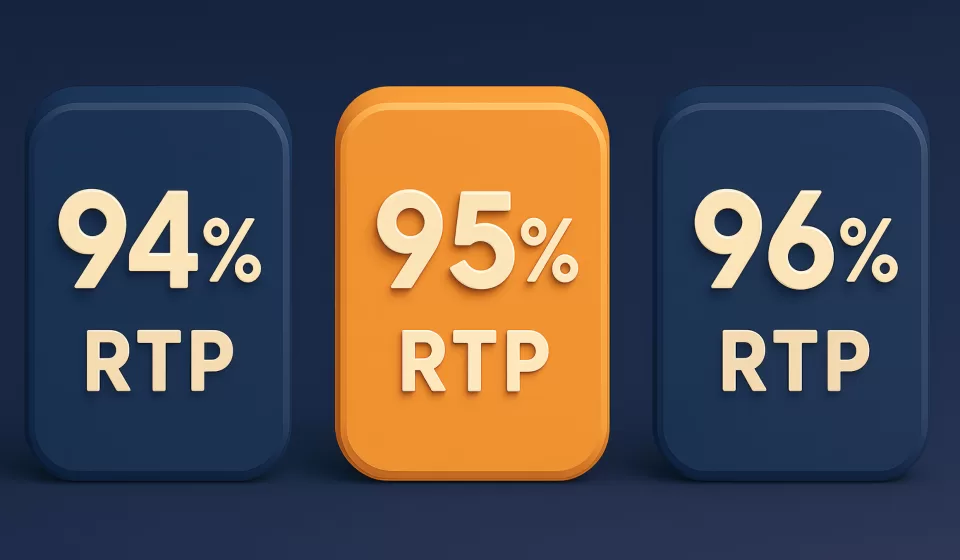
Whether you’re playing online slots, blackjack, or video poker, you’ve probably come across the term Return to Player (RTP). While many casino players pay attention to this percentage before choosing a game, not everyone fully understands what it actually represents. This is why having RTP percentages explained in simple terms is essential for making smarter decisions when gambling online.
RTP is often mistaken as a promise of guaranteed winnings, but that’s far from the truth. Instead, it is a mathematical calculation that estimates how much a game is expected to return to players over millions of rounds. Understanding how RTP works can help you compare games more effectively, manage your bankroll wisely, and develop realistic expectations before placing your bets.
In this guide, we’ll explain what RTP percentages really mean, how casino payout calculations are performed, and why slot return rates vary from one game to another. You’ll also learn the difference between RTP and volatility, discover common myths surrounding casino payouts, and find practical tips for choosing games that offer better long-term value.
If you’re new to online casinos, be sure to explore our Online Gambling Guide for more expert insights into casino games, bonuses, and responsible gambling practices before diving deeper into RTP.
What Does RTP Actually Mean?
Defining Return to Player (RTP)
When people search for RTP percentages explained, they’re usually looking for one simple answer: What does RTP actually tell me? Return to Player (RTP) is a theoretical percentage that estimates how much money a casino game is expected to pay back to players over an extended period of play.
For example, if an online slot has an RTP of 96%, it means the game is designed to return approximately $96 for every $100 wagered over millions of spins. The remaining 4% represents the casino’s mathematical advantage, commonly known as the house edge.
It’s important to understand that RTP is calculated over a very large sample size rather than a single gaming session. A player could win a large jackpot after only a few spins or lose their bankroll despite choosing a game with a high RTP. This randomness is what makes casino games both exciting and unpredictable.
Software developers determine RTP using complex mathematical models and extensive game simulations before a title is released. Licensed online casinos are generally required to display this information, allowing players to compare games and make more informed decisions before placing their bets.
Why Every Casino Game Has an RTP Percentage
Every legitimate casino game is built using a mathematical model that balances player returns with the casino’s long-term profitability. As a result, nearly every online slot, table game, and video poker title comes with its own published RTP percentage.
Different games naturally have different return rates. Classic table games such as blackjack and baccarat often feature RTP values above 99% when played using optimal strategy, while online slots usually fall between 94% and 97%, depending on the game developer and configuration selected by the casino.
The table below shows the typical RTP ranges across popular casino games.
| Casino Game | Typical RTP |
|---|---|
| Blackjack | 99%+ |
| Baccarat | 98%–99% |
| Video Poker | 98%–99.5% |
| Online Slots | 94%–97% |
| Roulette (European) | 97.3% |
Although RTP is a useful comparison tool, it should never be the only factor when choosing a game. Volatility, betting limits, bonus features, and overall gameplay experience can have just as much influence on your session.
How RTP Is Different from House Edge
One of the biggest misconceptions among casino players is thinking that RTP and house edge are two separate statistics. In reality, they’re simply opposite sides of the same equation.
If a game has an RTP of 96%, its house edge is 4%. Likewise, a game with a 97.3% RTP has a 2.7% house edge. Together, these figures always total 100%.
While RTP focuses on the amount theoretically returned to players over time, the house edge represents the casino’s expected profit from the same wagers. This is why games with higher RTP percentages generally provide better long-term value, even though they cannot guarantee individual wins.
For players comparing multiple casino games, understanding both numbers makes it easier to evaluate overall value. A difference of just one or two percentage points may seem small, but across thousands of wagers, it can significantly affect expected returns.
How RTP Percentages Are Calculated
Understanding Casino Payout Calculations
To fully understand RTP percentages explained, it’s important to know how these figures are created in the first place. Contrary to popular belief, RTP isn’t based on previous player results or adjusted manually by online casinos. Instead, it is determined through casino payout calculations performed during the game’s development.
Game providers use advanced mathematical models to estimate how much a game should theoretically return to players over an extremely large number of rounds. Every possible outcome, including standard wins, bonus features, jackpots, and losing spins, is included in these calculations to ensure the RTP accurately reflects the game’s long-term behaviour.
For instance, a slot machine with a published RTP of 96.2% is designed so that, over millions of simulated spins, it should return approximately $96.20 for every $100 wagered. The remaining percentage represents the casino’s expected advantage over time.
It’s worth noting that licensed game developers regularly have their RTP figures independently tested and verified by accredited auditing laboratories. This process helps ensure that the published return rates are fair, transparent, and compliant with gambling regulations in the jurisdictions where the games are offered.
Millions of Spins and Mathematical Probability
One of the biggest reasons players misunderstand RTP is because they apply long-term statistics to short-term results.
When developers calculate RTP, they don’t base it on a few hundred or even a few thousand spins. Instead, they simulate millions—or sometimes billions—of game rounds using sophisticated software to measure how the game performs over time.
Imagine flipping a coin ten times. While the expected probability is a 50/50 split between heads and tails, it’s completely normal to see seven heads and only three tails. However, after flipping the coin hundreds of thousands of times, the results gradually move much closer to the expected average.
Casino games work in a similar way. Individual sessions may produce outcomes that are significantly above or below the published RTP, but as the number of rounds increases, the overall return tends to move closer to the theoretical percentage.
This is why RTP should always be viewed as a long-term statistical indicator rather than a prediction of what will happen during your next gaming session.
Why RTP Represents Long-Term Performance
Many players assume that choosing a slot with a 97% RTP means they’ll recover most of their money during a single visit. Unfortunately, that’s not how casino mathematics works.
Every spin is completely independent of the previous one, meaning the game has no memory of past wins or losses. A player could experience an extended losing streak on a high-RTP slot, while another might land a substantial jackpot on a game with a lower return percentage.
Several factors influence short-term results, including random number generation (RNG), volatility, bonus features, and pure chance. RTP simply measures what the game is expected to return collectively over an enormous number of plays—not what any individual player will receive.
For this reason, experienced players often use RTP as one part of their decision-making process rather than relying on it alone. Combining a competitive RTP with sensible bankroll management, realistic expectations, and a trusted online casino generally provides a much better overall gaming experience than focusing solely on a single percentage.
Slot Return Rates Explained
Average RTP Across Popular Slot Games
Not all online slots are created equal. While most modern games operate within a similar RTP range, even a small percentage difference can influence the game’s expected long-term return. This is why experienced players often compare slot return rates before deciding which title to play.
In today’s online casino market, the average RTP for slots typically falls between 94% and 97%. Some premium titles from well-known software providers may even exceed 97%, while others with larger jackpot pools or unique bonus mechanics may feature a lower RTP to balance the game’s payout structure.
Although choosing a slot with a higher RTP can improve your theoretical long-term value, it’s important to remember that no slot machine can guarantee consistent winnings. RTP simply provides a useful benchmark when comparing games with similar themes, betting limits, or gameplay features.
The table below shows how slot RTP percentages are generally categorised.
| RTP Range | Category | What It Means |
|---|---|---|
| Below 95% | Lower RTP | Higher house edge and lower theoretical long-term returns. |
| 95%–96.5% | Average RTP | Common among many popular online slot games. |
| Above 96.5% | High RTP | Better theoretical return over time, though wins are still random. |
Rather than chasing the highest percentage available, players should also consider factors such as volatility, bonus rounds, betting options, and overall entertainment value.
Why High RTP Doesn’t Guarantee Bigger Wins
A common misconception is that a slot with a higher RTP automatically pays out more frequently or offers larger prizes. In reality, RTP only reflects the game’s expected return over millions of spins—it doesn’t determine when or how individual wins occur.
For example, imagine two slot games:
- Game A: 97% RTP with high volatility.
- Game B: 95% RTP with low volatility.
Although Game A has a better theoretical return, it may produce longer losing streaks before awarding significant payouts. Game B, on the other hand, may deliver smaller wins more regularly, creating a smoother playing experience despite having a slightly lower RTP.
This is why many experienced players look beyond RTP alone. They consider how often the game pays, the size of potential wins, and whether the gameplay matches their preferred level of risk. Understanding these factors together provides a much clearer picture than focusing on a single percentage.
RTP vs Jackpot Potential
Progressive jackpot slots often create another source of confusion for players researching RTP. Since these games can award life-changing prizes, many assume they must also have the highest return percentages.
In reality, progressive jackpots usually work differently. A small portion of every wager contributes to the growing jackpot pool, which can slightly reduce the game’s base RTP compared to standard online slots. However, the opportunity to win a massive jackpot is what attracts many players despite the lower theoretical return.
By contrast, non-progressive slots may offer a higher published RTP because they distribute more of their payouts through regular gameplay rather than reserving funds for a shared jackpot prize.
Neither option is inherently better. If your goal is to maximise long-term value, choosing games with competitive RTP percentages may be the smarter approach. If you’re comfortable accepting greater risk in exchange for the possibility of a huge payout, progressive jackpot slots may provide a more exciting experience.
Ultimately, understanding slot return rates helps you compare games more effectively and select titles that align with your budget, playing style, and expectations.
RTP vs Volatility: Understanding the Difference
Many players assume that RTP and volatility measure the same thing, but they actually describe two completely different aspects of a casino game. Understanding both concepts will help you choose games that better match your budget, risk tolerance, and playing style.
While RTP measures the theoretical percentage of money returned to players over the long run, volatility describes how those returns are distributed. In other words, volatility affects the frequency and size of payouts rather than the overall expected return.
A slot with a high RTP can still produce long periods without significant wins if it also has high volatility. Likewise, a lower-volatility slot may award smaller payouts more frequently, even if its RTP is slightly lower.
High RTP with High Volatility
Some of the most popular online slots combine a competitive RTP with high volatility. These games are designed to offer larger potential payouts, but players may need to endure longer losing streaks before those rewards appear.
This type of game often appeals to experienced players who are comfortable taking on more risk in exchange for bigger winning opportunities. However, it also requires careful bankroll management, as sessions can fluctuate dramatically.
For example, a slot with a 97% RTP and high volatility may theoretically provide excellent long-term value, but an individual player could still experience hundreds of spins without landing one of its premium bonus features.
Low RTP with Low Volatility
Lower-volatility games work differently. Instead of focusing on large but infrequent payouts, they tend to reward players with smaller wins on a more regular basis.
Although these games may not offer the same jackpot potential, they often provide a steadier gameplay experience that allows bankrolls to last longer. This makes them a popular choice for casual players who value consistent entertainment over chasing massive prizes.
It’s important to remember that lower volatility doesn’t eliminate the house edge, nor does it increase the game’s RTP. It simply changes how winnings are distributed throughout the session.
Choosing the Right Balance
Rather than asking whether RTP or volatility is more important, players should consider how the two work together.
If your goal is to extend your playing time, a slot with a competitive RTP and medium or low volatility may offer a more balanced experience. On the other hand, players who enjoy the excitement of larger bonus rounds or jackpot-style payouts may prefer high-volatility games, even if they require greater patience.
Ultimately, there is no universally “best” combination. The right choice depends on your bankroll, your expectations, and how much risk you’re willing to accept during each gaming session.
Can Online Casinos Change RTP Percentages?

One question that frequently appears in discussions about RTP percentages explained is whether online casinos can simply adjust a game’s payout whenever they want. The short answer is sometimes—but only within strict limitations.
In most cases, the RTP of a casino game is determined by the software provider rather than the casino itself. Developers may release several approved RTP configurations for the same game, allowing licensed operators to select from predefined versions instead of creating their own payout percentage.
For example, a slot might be available with RTP settings of 96.5%, 95.5%, or 94.5%. If multiple configurations exist, the casino chooses one before the game goes live, and that setting generally remains fixed until it is officially changed in accordance with licensing requirements.
Fixed RTP Games
Many online casino games operate with a single RTP configuration. Once these games are launched, every player experiences the same theoretical return regardless of when they play or how much they wager.
Licensed casinos cannot manually increase or decrease payouts for individual players, nor can they influence the outcome of specific spins. Every result continues to be generated independently through the game’s Random Number Generator (RNG).
This is one of the key reasons why playing at regulated online casinos is so important. Licensed operators must use certified software that has been independently tested to ensure fairness and compliance.
Multiple RTP Versions from Software Providers
Some game developers provide operators with several RTP options to suit different markets or business models. While this practice is legal in many regulated jurisdictions, the available versions are still created and certified by the software provider—not by the casino.
As a result, two different casinos may offer the same slot title with slightly different RTP percentages. The difference is often small, but over the long term it can influence the game’s expected return.
Players who compare casinos before signing up may therefore benefit from checking whether a game’s published RTP matches the version they prefer.
Why Transparency Matters
A trustworthy online casino should clearly display game information or make RTP details easily accessible to players. Transparency allows users to compare games fairly and understand the theoretical return before placing any bets.
If an operator hides important game information or provides little detail about the software it uses, it may be worth considering a more reputable alternative. Choosing licensed casinos that work with established game providers not only improves transparency but also gives players greater confidence that published RTP figures accurately reflect the game’s mathematical design.
Conclusion
Understanding RTP percentages explained is an important step toward becoming a more informed online casino player. While RTP provides valuable insight into a game’s theoretical long-term return, it should never be viewed as a guarantee of future winnings. Every spin, hand, or round is determined independently, meaning short-term results can vary significantly from the published percentage.
By learning how casino payout calculations work and comparing slot return rates across different games, you can make smarter decisions based on expected value rather than common misconceptions. Combining RTP with factors such as volatility, bankroll management, and game selection will help you build a more balanced and enjoyable gambling experience.
If you’re looking to expand your knowledge, explore our Online Gambling Guide for expert casino strategies, game comparisons, and responsible gambling advice. You can also visit our Online Gambling News section to stay updated on the latest industry developments, or return to the CasinoPrego homepage to discover trusted online casino reviews, exclusive bonus offers, and comprehensive gaming resources.